Guide
New Grad Nurse Resume Template: How to Present Clinicals as Experience
Nurse residency programs and hiring managers know new graduates don’t have years of RN experience. What they’re looking for is evidence that you’re safe, teachable and ready for a full assignment with support. A new grad nurse resume template should make that evidence easy to find: licenses up front, clinical experience presented like real experience, and any patient-care job you’ve held.
Here’s how to fill in each section.
Header and credentials
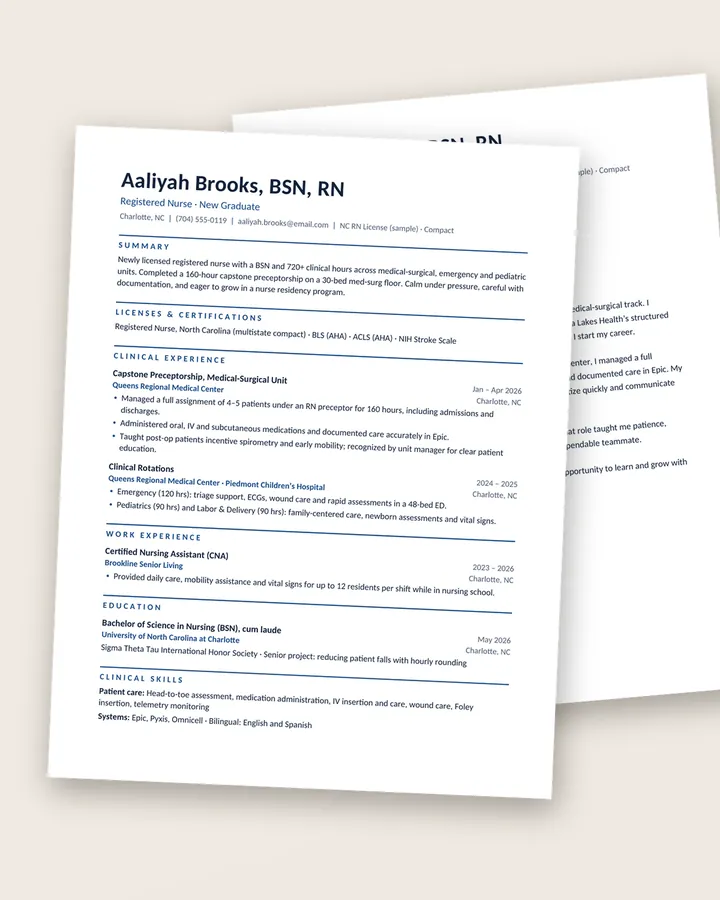
Put your credentials after your name: Aaliyah Brooks, BSN, RN. If you’re waiting on the NCLEX, leave “RN” off until you’re licensed and use your degree (BSN) instead.
Below your name, add your city and state, phone, a professional email and, if you like, your LinkedIn profile.
Summary: three lines for the residency coordinator
A short summary helps a recruiter match you to the right unit. Include your degree, total clinical hours, your strongest specialty exposure and what you’re looking for:
Newly licensed registered nurse with a BSN and 720+ clinical hours across medical-surgical, emergency and pediatric units. Completed a 160-hour capstone preceptorship on a 30-bed med-surg floor. Eager to grow in a nurse residency program.
Licenses and certifications, right under the summary
This is the first thing many nurse recruiters check, so don’t bury it in education:
- Registered Nurse, [State] (and “multistate compact” if it applies), or “NCLEX-RN scheduled June 2026”
- BLS (AHA), plus ACLS, PALS or NRP if you hold them
- NIH Stroke Scale or other unit-relevant certifications
Clinical experience: treat it like a job
This is the heart of a new grad nursing resume. Give your capstone preceptorship its own entry with the facility, unit type, dates and hours, then three or four specific bullets:
- Managed a full assignment of 4–5 patients under an RN preceptor for 160 hours, including admissions and discharges.
- Administered oral, IV and subcutaneous medications and documented care in Epic.
- Taught post-op patients incentive spirometry and early mobility.
Then group your other rotations into one entry, one line per specialty:
- Emergency (120 hrs): triage support, ECGs, wound care and rapid assessments in a 48-bed ED.
- Pediatrics (90 hrs) and Labor & Delivery (90 hrs): family-centered care, newborn assessments.
Mention the patient ratio, unit size and charting system when you know them. Those details help a manager picture you on their floor.
Work experience: CNA, PCT, EMT, scribe
Paid healthcare work is a real advantage. Put it in its own section below clinicals:
- Provided daily care, mobility assistance and vital signs for up to 12 residents per shift while in nursing school.
Non-healthcare jobs (retail, food service) can still help if they show reliability and customer service, but keep them to a line each.
Education
Degree, school, graduation date, and honors (cum laude, Sigma Theta Tau). A senior project or evidence-based practice project relevant to the unit is worth one line.
Clinical skills
Group them so they scan quickly:
- Patient care: head-to-toe assessment, medication administration, IV insertion and care, wound care, Foley insertion, telemetry monitoring
- Systems: Epic, Pyxis, Omnicell
- Languages: if you’re bilingual, say so; it’s genuinely valuable on most units
Choosing a nursing resume template
- Licenses-first structure. A section dedicated to licenses and certifications above your experience.
- Separate “Clinical Experience” and “Work Experience” sections, so rotations read as experience instead of coursework.
- Single column. Hospital applicant tracking systems (Workday, Taleo, iCIMS) read single-column layouts most reliably.
- One page is right for almost every new grad.
- A matching cover letter for residency applications that ask for one.
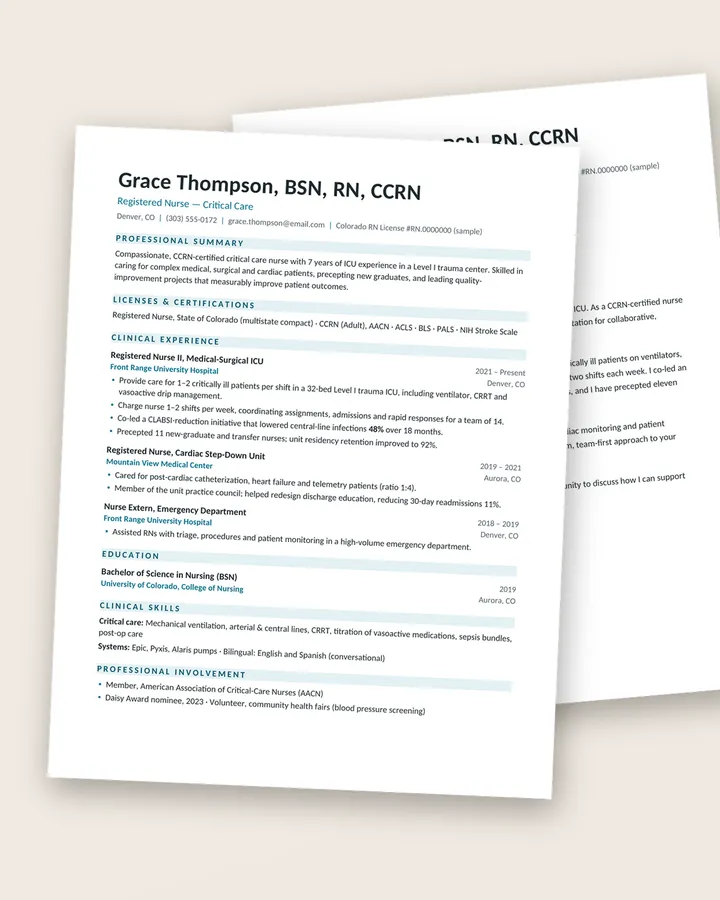
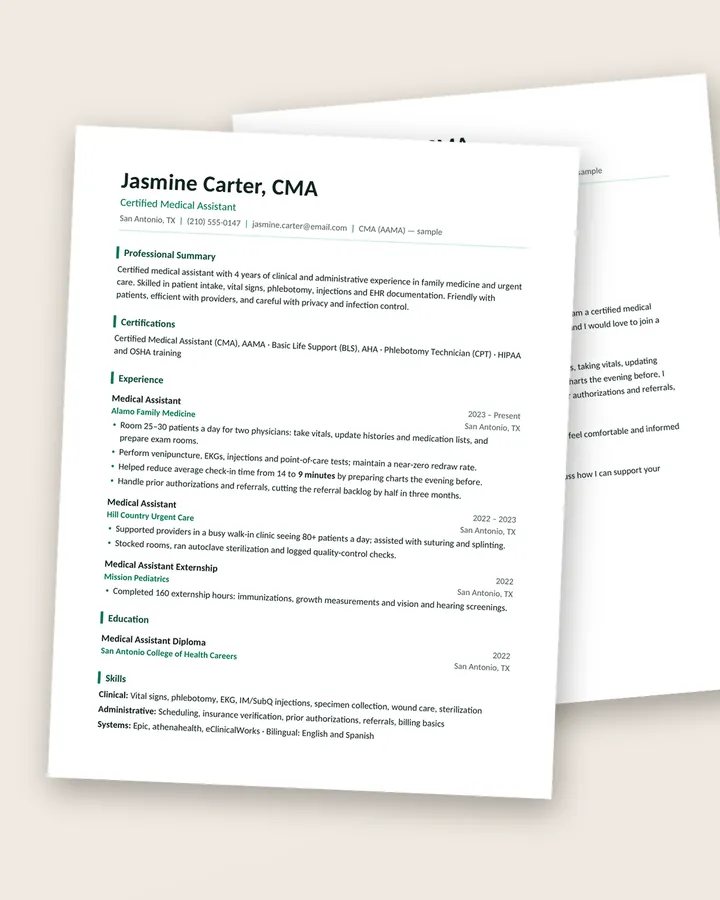
Our Beacon new grad nurse resume template follows exactly this structure, with a matching cover letter written for a residency application. Once you have a year or two of RN experience, Haven is set up for experienced nurses, with room for units, ratios and charge or precepting duties. If you’re a medical assistant or patient care tech, Vital separates clinical and front-office skills.
For more detail on experienced-RN resumes, read how to write a nursing resume.
Before you submit
- Credentials match your current status (no “RN” before you’re licensed).
- Your capstone preceptorship has hours and specific bullets.
- The unit you’re applying to is reflected in your summary and top bullets.
- Certifications are current, with the issuing body.
- You’ve run through the free Résumé Checklist.
Free download
The Résumé Checklist
38 practical checks to run before you hit send, from your header and bullets to ATS formatting and file names. A 3-page PDF, free.
Frequently asked questions
Can I apply before I pass the NCLEX?
Many nurse residency programs accept applications before you're licensed. List your degree with the graduation date and write 'NCLEX-RN scheduled [month year]' or 'RN license expected [month year]' in your licenses section. Follow each employer's instructions.
How many clinical rotations should I list?
Give your capstone or preceptorship its own entry with three or four bullets, then group the rest under one 'Clinical Rotations' entry with a line per specialty and the hours. Prioritize rotations closest to the unit you're applying to.
Should I include my CNA or patient care tech job?
Yes. Paid patient-care work shows you already know hospital routines, teamwork and time management. List it under a separate Work Experience section below your clinical experience.
Is a GPA worth listing on a nursing resume?
If it's 3.5 or higher, or if a residency program asks for it, include it. Honors like Sigma Theta Tau are also worth a line.