Guide
Cover Letter Format: A Simple Structure That Works for Any Job
A good cover letter is short, specific and easy to skim. The format below works for almost every industry. Adjust the tone, not the structure.
The structure at a glance
- Header: your name and contact details (match your resume)
- Date and employer details (optional in emailed or uploaded letters)
- Greeting
- Opening paragraph: the role and your one-line pitch
- Middle paragraph(s): evidence that you can do the job
- “Why here” paragraph: what draws you to this employer
- Closing: next step and thanks
- Sign-off and name
1. Header
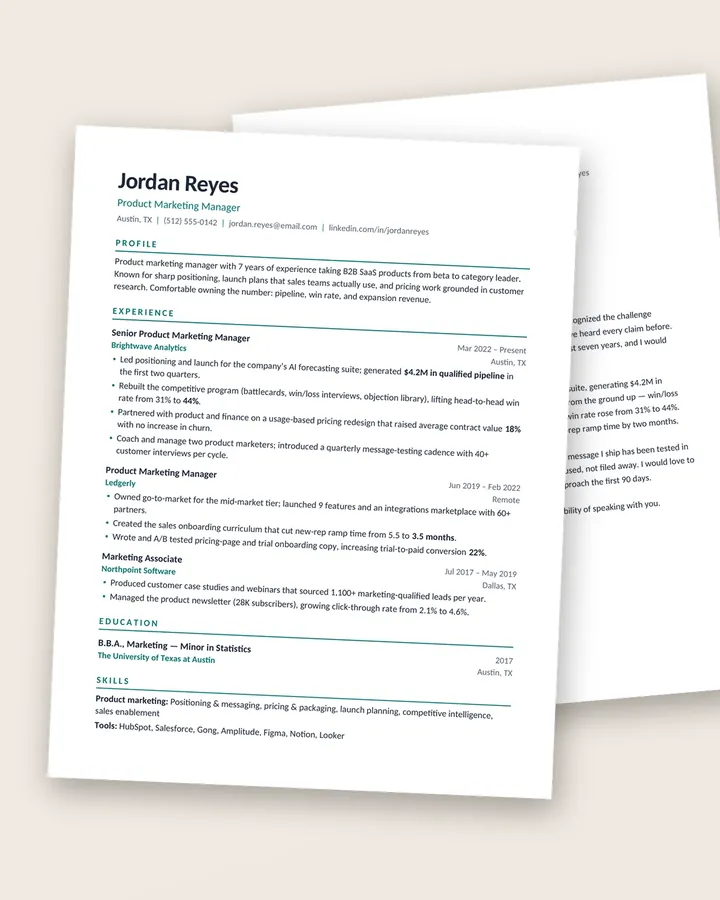
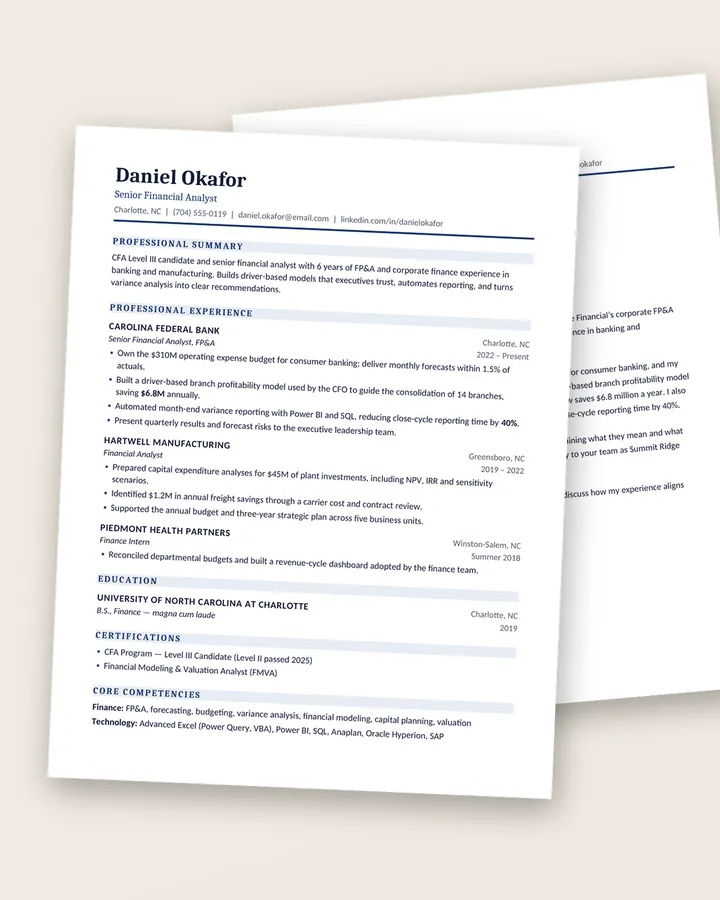
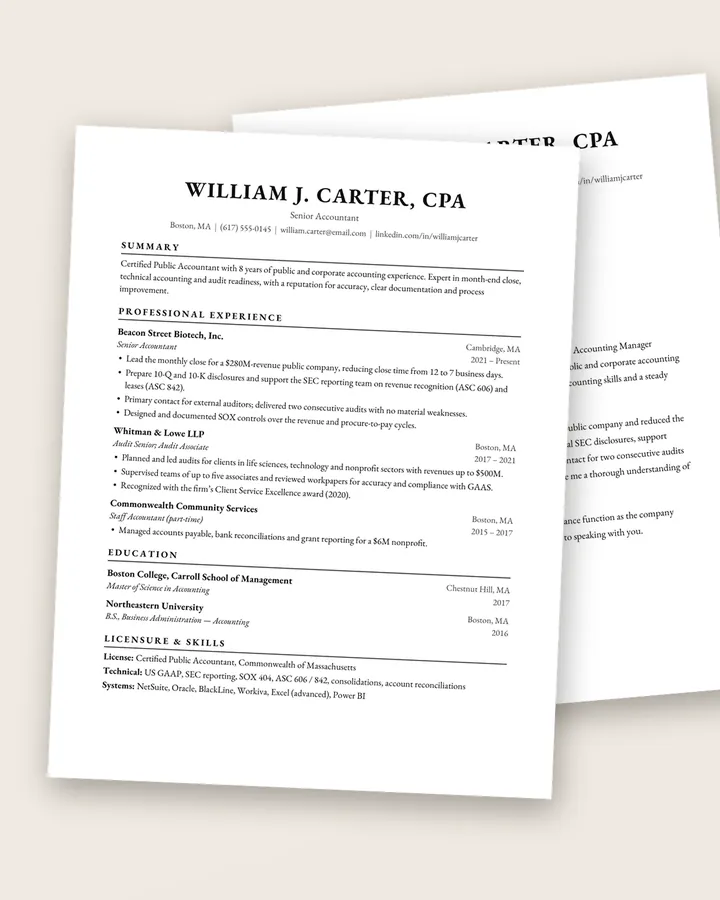
Use the same name, contact line and design as your resume. When a recruiter sees both documents together, they should clearly belong to one person. Include your email, phone, city and state, and a LinkedIn or portfolio link if relevant. A full street address isn’t necessary.
2. Date and employer details
For a printed or formal letter (law, government, some finance roles), include the date, then the hiring manager’s name, title, company and address. For online applications, many people simply include the date and company name, which is fine.
3. Greeting
Use a name if you can find one: Dear Ms. Patel, or Dear Jordan Kim,. Otherwise Dear Hiring Manager, is professional and safe. Avoid “To whom it may concern,” which reads as impersonal.
4. Opening paragraph: role + pitch
Two or three sentences. Name the role, then give the single strongest reason you fit.
I’m applying for the Senior Product Marketing Manager role on the Payments team. Over the last seven years I’ve launched B2B products from beta to category leader, most recently a forecasting suite whose launch plan I owned end to end.
Skip the “My name is…” and “I am writing to express my interest…” openings. Your name is already at the top.
5. Evidence paragraph(s)
Pick two or three requirements from the job posting and show, with specific examples, that you’ve done them. Each example should say what you did and what changed because of it.
You can write this as one paragraph or as a short paragraph followed by two or three bullets. Bullets are easy to skim and work well in most industries.
6. Why this employer
One short paragraph that shows you understand what the company does and why it appeals to you: a product you use, a market they’re entering, a value or mission that matches how you work. Be concrete; generic praise is easy to spot.
7. Closing
Thank them, restate your interest in one line, and invite the next step:
Thank you for your time. I’d welcome the chance to talk about how I could help the Payments team grow adoption next year.
8. Sign-off
Sincerely, Best regards, or Kind regards, followed by your full name. In an uploaded document, a typed name is enough.
Formatting rules
- Length: about 250–400 words, one page.
- Font: the same as your resume, 10.5–12 pt.
- Margins: around 0.75–1 inch.
- Spacing: single-spaced, with a blank line or paragraph spacing between paragraphs.
- Alignment: left-aligned (ragged right) reads more naturally than justified text.
- File: PDF unless the posting asks for Word. Name it
Firstname-Lastname-Cover-Letter.pdf.
Matching resume and cover letter templates
Every ResumeForge template includes a cover letter with the same header and typography, already laid out in this structure with a realistic example letter to adapt. For a modern look see Meridian, for finance and consulting Sterling, and for law and other traditional fields the classic Garamond Hampton. You can also browse all the cover letter templates side by side.
Free download
The Résumé Checklist
38 practical checks to run before you hit send, from your header and bullets to ATS formatting and file names. A 3-page PDF, free.
Frequently asked questions
How long should a cover letter be?
Usually 250–400 words, which fits comfortably on one page. Three or four short paragraphs are enough for most roles.
Who should I address a cover letter to if I don't know the name?
Try the job posting, the company's site or LinkedIn for the hiring manager's name. If you can't find it, 'Dear Hiring Manager' or 'Dear [Team] Hiring Team' is perfectly acceptable.
Should my cover letter match my resume design?
It helps. Using the same header, font and colors makes your application look like one coherent package. Every ResumeForge template includes a matching cover letter for that reason.