Guide
How to Write a Nursing Resume: From New Grad to Experienced RN
A nursing resume has one job above all: make it easy for a nurse manager or recruiter to confirm, in seconds, that you hold the right license and certifications and have worked in a setting like theirs. Everything else supports that.
Put credentials where they’re seen first
Hiring teams check credentials before anything else, so don’t bury them.
- Name line: add your credentials after your name, for example Maria Lopez, BSN, RN.
- Licenses & certifications section near the top, before or right after your summary:
- RN license with state (and compact/multistate status if it applies)
- BLS, ACLS, PALS, NRP, TNCC or specialty certifications such as CCRN or CEN, with expiry dates if they’re current
- Spell out a certification once if it’s less common, then use the abbreviation.
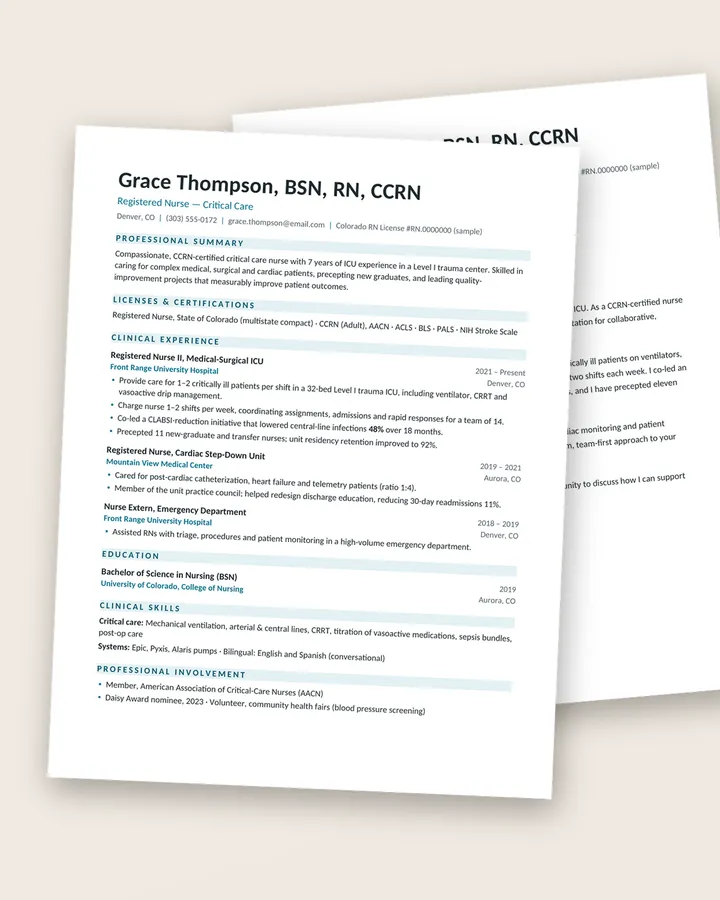
Our Haven nursing resume template puts a “Licenses & Certifications” block right after a short summary, so credentials are visible without scrolling.
Write a short, specific summary
Two or three lines are enough. Say what kind of nurse you are, where, and what you’re looking for.
Med-surg RN with three years on a 32-bed telemetry unit. Charge nurse experience, strong with new-grad precepting and EHR documentation. Seeking a step-down or ICU role.
Avoid generic phrases (“compassionate, hard-working team player”). Your experience bullets can demonstrate those qualities more convincingly.
Describe clinical experience the way nurses talk about it
For each position, include the facility, unit type, bed count if you know it, and dates. Then use bullets that show scope and judgment:
- Typical patient ratio and acuity (“Cared for 4–5 telemetry patients per shift…”)
- Populations (pediatrics, geriatrics, post-surgical, oncology)
- Systems and equipment (Epic, Cerner, PCA pumps, ventilators, central lines)
- Responsibilities beyond direct care: charge nurse, precepting, committees, quality projects
- Specific outcomes where you have them, such as a fall-prevention initiative you helped run or a documentation audit you led. Use only numbers you can verify.
New grad nursing resume: lead with education and rotations
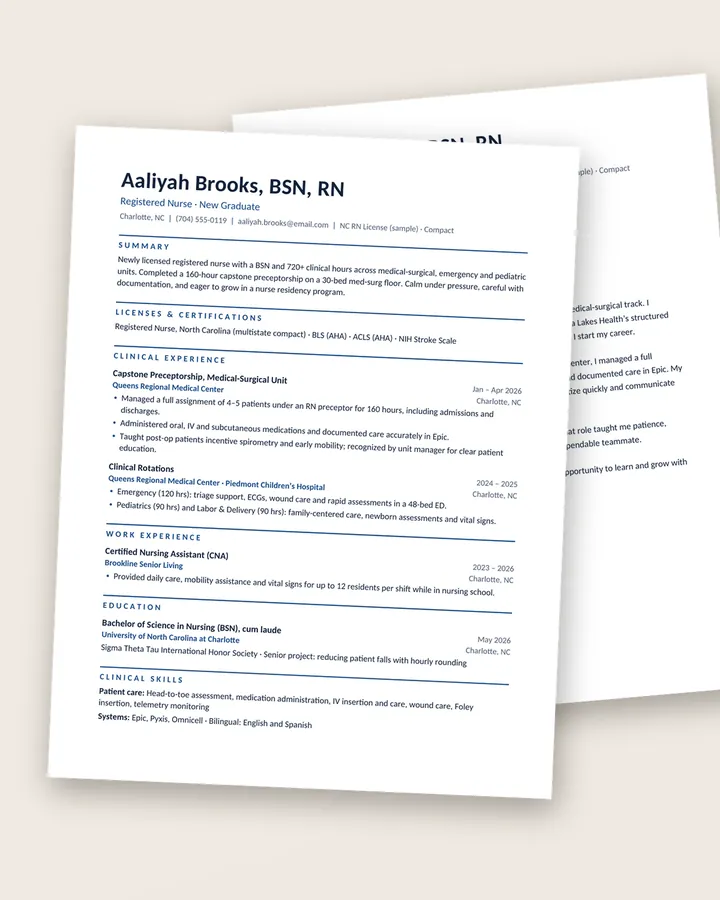
If you’re a new graduate, your structure changes slightly:
- Header and credentials (RN license, or “NCLEX-RN scheduled for [month]” if that’s accurate)
- Education: BSN or ADN, school, graduation date; honors if you have them
- Clinical rotations: facility, unit type, hours, and one or two concrete details each
- Capstone or preceptorship: usually your most substantial experience, so give it its own entry
- Work experience: CNA, patient care tech, EMT, medical scribe, or any job that shows reliability
- Skills and certifications
A capstone entry might read:
- Capstone preceptorship, Cardiac Step-Down, 144 hours. Managed full assignment of 3–4 patients under RN preceptor, including medication administration, telemetry monitoring and discharge teaching.
Experienced RN resume: show progression and specialty
Once you have several years of experience, the education section moves to the bottom and your work history leads. Make your specialty obvious from the job titles and the first bullet of each role. If you’ve moved between specialties, consider a one-line summary for each position before the bullets.
Travel nurses can group short contracts under one heading (“Travel RN, Various Agencies, 2023–2025”) and list each assignment with facility, unit and length, which keeps the page readable.
Keep it ATS-friendly
Hospital systems commonly use applicant tracking systems. Use a single-column layout, standard headings (Licenses & Certifications, Experience, Education, Skills) and a text-based file. Our guide to ATS-friendly resume formatting covers the details.
Don’t forget the cover letter
A short cover letter that names the unit and explains why that unit still stands out in nursing hiring, especially for new grads and specialty transitions. See our cover letter format guide for a simple structure. Every ResumeForge template, including Haven, comes with a matching cover letter.
Free download
The Résumé Checklist
38 practical checks to run before you hit send, from your header and bullets to ATS formatting and file names. A 3-page PDF, free.
Frequently asked questions
Should I put my nursing license number on my resume?
Many nurses list the license type and state (for example, RN, State of Ohio) and add the number only when the application asks for it, since employers verify licenses through official lookups. Follow the employer's instructions.
How long should a nursing resume be?
One page is typical for new graduates. Experienced nurses with several roles, specialties or leadership duties often use two pages. Keep whatever is most relevant to the unit you're applying to near the top.
Do new grads list clinical rotations?
Yes. For a new graduate, clinical rotations are your most relevant experience. List the facility, unit type and hours if you know them, plus one or two specific things you did.