Guide
Car Sales Resume: How to Show Units, CSI and Repeat Business
A dealership sales manager reading your resume is asking one question: will this person sell cars here without burning customers or the store’s reputation? They can answer it in about ten seconds if your resume puts the right proof up front: how many units you move, how customers rate you, and how much of your business comes back.
This guide walks through each section of a car sales resume, with example bullets you can adapt. The examples are illustrations only. Replace every number with your own.
What dealership managers actually look for
Before you write a word, know what you’re being judged on. In most dealerships that means:
- Volume. Average units per month, and whether that number is steady or improving.
- Customer satisfaction. CSI or survey scores. Manufacturers tie money to these, so managers care a lot.
- Gross and products. Front-end gross per unit, and how often your deals include financing and protection products.
- Repeat and referral business. A salesperson with a book of loyal customers is worth more than one who starts from zero every month.
- Process discipline. Logging every lead in the CRM, following up, booking appointments that show.
- Stability. Many dealerships worry about turnover. Reasonable tenure at past stores is a plus.
Your resume should answer each of these somewhere on one page.
Header and title
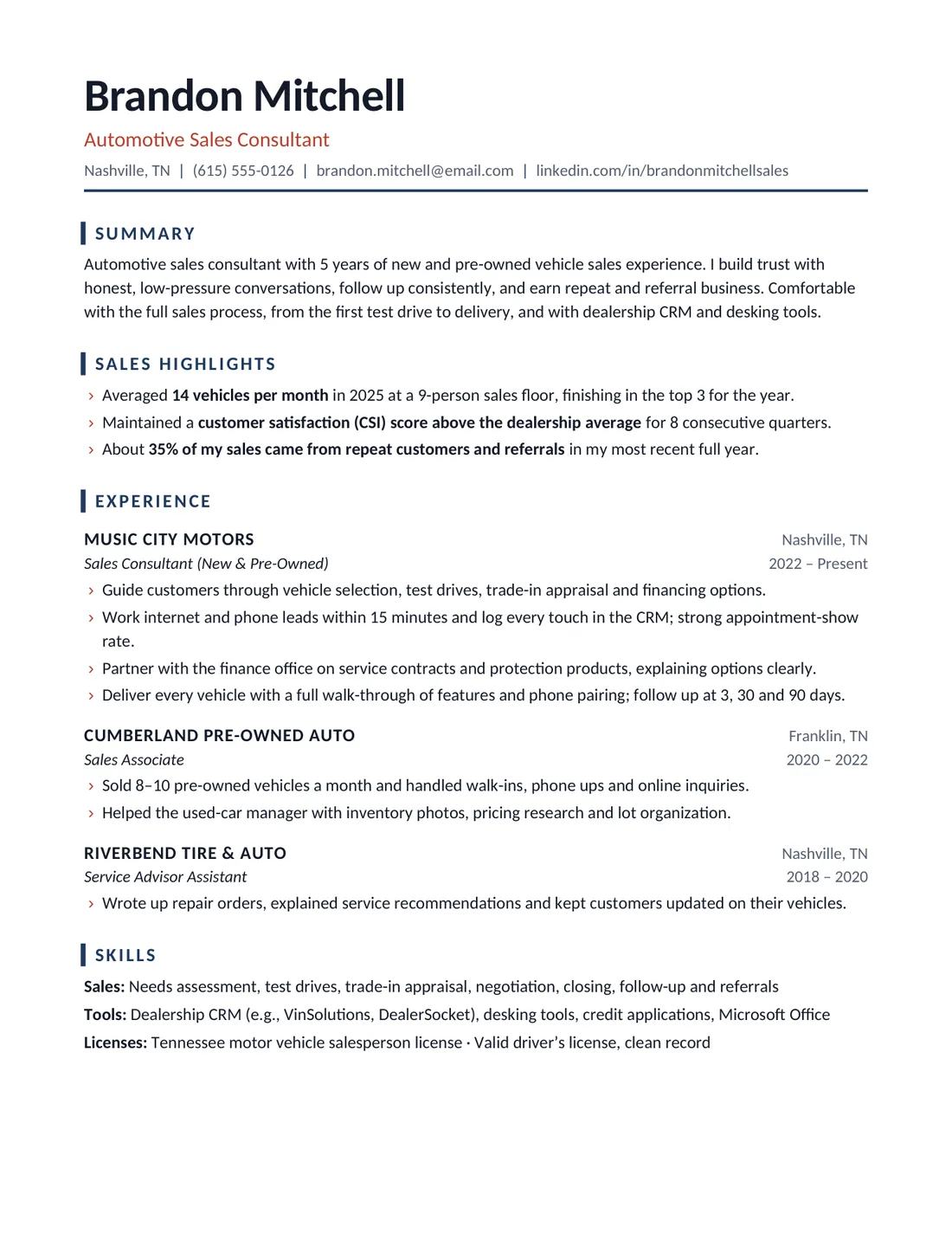
Under your name, write the title of the job you want, not a vague label: Automotive Sales Consultant, New & Pre-Owned Sales Consultant, or Internet Sales Manager. Add your city and state, phone and email. A LinkedIn link is optional. Skip your full street address.
Summary: three sentences, no clichés
“Results-driven sales professional” tells a manager nothing. Instead, say how long you’ve sold, what you’ve sold, and how you sell:
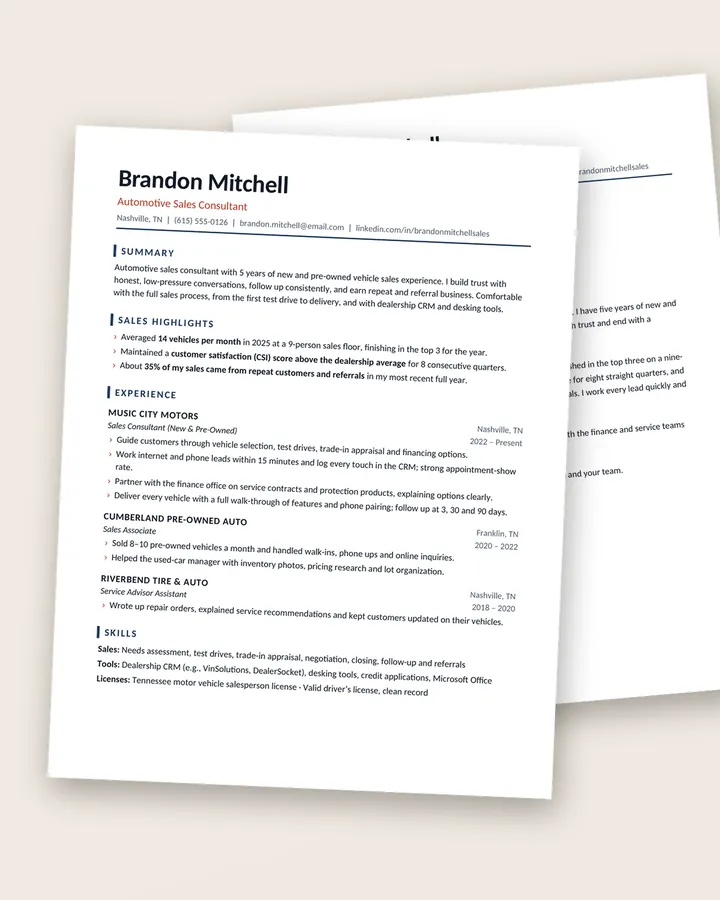
Example: Automotive sales consultant with 5 years in new and pre-owned sales at high-volume franchise stores. I build trust with honest, low-pressure conversations, follow up consistently, and earn a steady stream of repeat and referral customers. Comfortable with the full process from first contact to delivery.
If you’re coming from another industry, name the transferable strength: “Retail sales lead moving into automotive, with 3 years of hitting add-on targets and handling customer objections.”
Sales Highlights: your numbers before your job history
This is the most important block on a car sales resume. Put three or four of your best, verifiable results directly under the summary, so the reader sees them before they reach your work history.
Example highlights (fictional, replace with your own):
- Averaged 14 units per month over the last 2 years; top 3 of 12 consultants in 2025.
- CSI consistently above the regional average.
- About 40% of annual sales from repeat customers and referrals.
- Strong F&I handoffs: product penetration above the store average.
Only use numbers you can back up. A sales manager may call your old dealership, and any interviewer will ask how you got there. If you don’t know an exact figure, a range (“12–16 units a month”) or a rank (“consistently top half of the sales board”) is fine and honest.
Experience: bullets that show how you sell
Under each dealership, include the store name, the brand or brands, the city, your title and dates. Then write three to five bullets. Mix numbers with how you got them, because managers want to know your process is repeatable.
Example bullets (fictional):
- Sell new and certified pre-owned vehicles at a Toyota store averaging 250 units a month; consistently top-quartile in units and CSI.
- Built a personal follow-up routine in the CRM (daily calls, birthday and service-visit check-ins) that turned past buyers into 5–6 referral sales a month.
- Converted internet and phone leads into showroom appointments, with a show rate well above the store goal.
- Worked closely with F&I and the service drive to make deliveries smooth; regularly asked to train new consultants on walkarounds and test drives.
- Handled trade-in appraisals with the used-car manager and explained numbers clearly, reducing deals lost at the desk.
Notice what these bullets avoid: “responsible for selling cars”, “greeted customers”, “met quota”. Everyone did those things. Show the result and the habit behind it.
If you came from the service drive, BDC or retail
Plenty of good salespeople start somewhere else in the dealership or in retail. Frame those jobs around selling:
- Service advisor: recommended maintenance, upsold services, kept customer satisfaction high, built relationships with owners who later bought cars.
- BDC representative: calls and texts per day, appointments set, appointment show rate.
- Retail or restaurant: add-on or upsell rates, loyalty sign-ups, handling complaints, working on targets.
Skills: specific tools and techniques
A grouped skills list helps both the manager and any applicant tracking system:
- Sales process: needs assessment, walkarounds, test drives, negotiation, trade-in appraisal, delivery
- Follow-up and prospecting: CRM follow-up, phone and text prospecting, referral programs, service-drive conquest
- Systems: the dealership CRM and desking tools you’ve used (for example VinSolutions, DealerSocket, Elead or CDK), plus Microsoft Office
- Product: brand certifications, EV and hybrid knowledge, financing basics
- Languages: if you’re bilingual, list it. It’s a real advantage on most showroom floors.
Only list systems you have actually used.
Licenses, certifications and education
Put these in a short section near the bottom:
- Driver’s license (most dealerships require a valid license and an insurable driving record).
- State salesperson license, if your state requires one for vehicle sales.
- Manufacturer certifications and any sales training you completed.
- Education: high school diploma or GED is enough for most dealerships. Add college if you have it, but it isn’t the deciding factor. If you don’t have a degree, see how to write a resume with no degree.
Your cover letter: answer the turnover question
Dealerships hire often and lose people often, so a short cover letter that shows you’ll stick and sell is worth sending. In three short paragraphs:
- Name the store and the role, and one reason you want to sell their brand.
- Give your two best numbers and the habit behind them (follow-up, referrals, CSI).
- Say when you can start and that you’re comfortable with evening and weekend schedules if that’s true.
Every ResumeForge template comes with a matching cover letter. For general structure, see our cover letter format guide.
Common car sales resume mistakes
- No numbers at all. If you sold cars, you were tracked. Find your figures.
- Inflated numbers. Sales managers know what’s realistic for a store’s volume. An unbelievable number hurts more than a modest true one.
- Listing every job since high school. Keep the last 10 years or so, focused on sales and customer roles.
- Unexplained short stints. If you moved stores quickly, one honest line (“store sold to a new group”) helps.
- A design that hides the numbers. Busy two-column layouts and graphics can confuse application systems. A clean single column works best. See how to choose an ATS-friendly resume template.
Moving from car sales to another kind of sales?
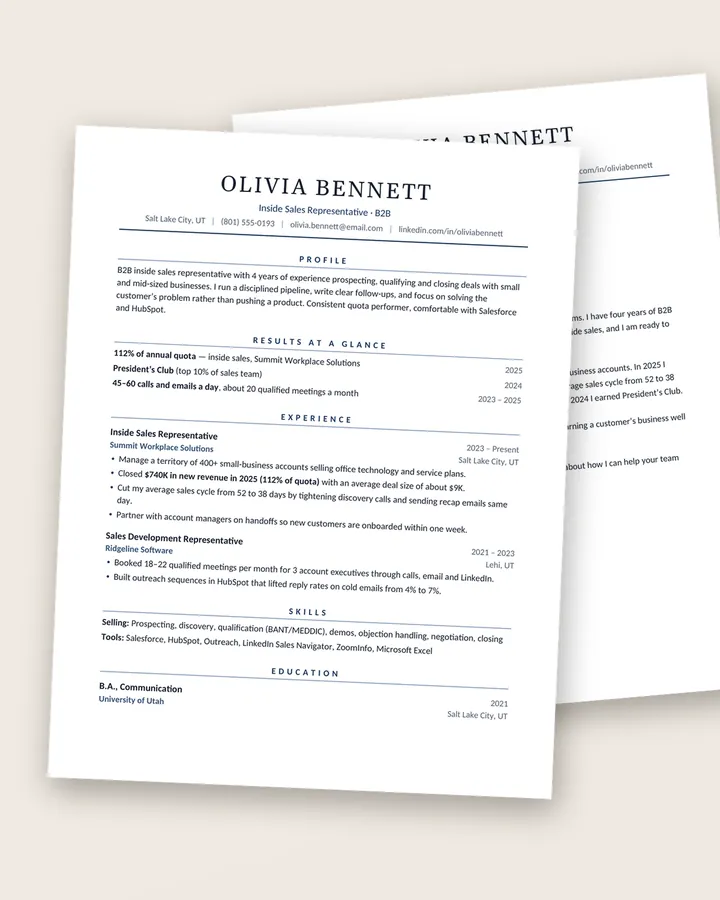
Car sales experience translates well to B2B and inside sales, because you’ve worked leads, handled objections and lived on a scoreboard. The difference is that B2B employers think in quota, pipeline and revenue rather than units. Our B2B and inside sales resume guide shows how to reframe your results.
Choosing a car sales resume template
Look for a template with:
- A highlights block near the top for your numbers.
- One page, a single column and real text (not images), so it prints and parses cleanly.
- Room for the brand and store in each job line.
- A matching cover letter.
The Torque car sales resume template is built exactly this way, with a Sales Highlights section, skills grouped for dealership roles, and a matching cover letter in Word and Google Docs. If you’re targeting B2B sales instead, look at Pipeline. For the plainest possible layout, use Clarity.
Before you send it
- Your title under your name says Automotive Sales Consultant (or the exact title in the posting).
- Your best three numbers are visible in the top third of the page.
- Each dealership line includes the brand.
- Your license and certifications are easy to find.
- You’ve checked it against our free Résumé Checklist.
Free download
The Résumé Checklist
38 practical checks to run before you hit send, from your header and bullets to ATS formatting and file names. A 3-page PDF, free.
Frequently asked questions
What numbers should go on a car sales resume?
The ones your dealership actually tracked: average units per month, your rank on the sales board, CSI or customer survey scores, front-end or back-end gross per unit, F&I product penetration, appointment show and close rates, and the share of your sales that came from repeat or referral customers. Use real figures or honest ranges you could explain in an interview.
How do I write a car sales resume with no sales experience?
Lead with transferable proof: retail or restaurant jobs where you hit upsell targets, service advisor or BDC roles, any commission work, and customer-facing jobs where you handled objections or complaints. Mention a valid driver's license and a clean driving record, which most dealerships require, and say you are ready to learn the dealership's process.
Should I list the brands I've sold?
Yes. Brand experience (for example Toyota, Ford or a luxury brand) and new versus pre-owned experience help a sales manager picture you on their floor. Put the brand in the job line or the first bullet.
Is one page enough for a car sales resume?
For most consultants, yes. A sales manager wants to see your numbers, your dealerships and your dates quickly. Two pages only make sense for sales managers or finance managers with a long track record.
Do I need to mention my license and certifications?
Mention a valid driver's license, and any state salesperson license where your state requires one, plus manufacturer certifications you hold. These are often screening questions, so making them easy to find saves the manager time.