Guide
How to Write a Resume With No Degree (and Still Get Interviews)
Plenty of good jobs don’t need a college degree, and a growing number of employers now hire on skills and experience instead. But your resume still has to do extra work: it needs to make your experience so clear that nobody misses the missing line in the education section.
This guide is for people who have work experience but no college degree. (If you’re just starting out with little work history, our entry-level resume guide is the better fit.) The examples are illustrations. Replace them with your own.
The core idea: lead with proof, end with education
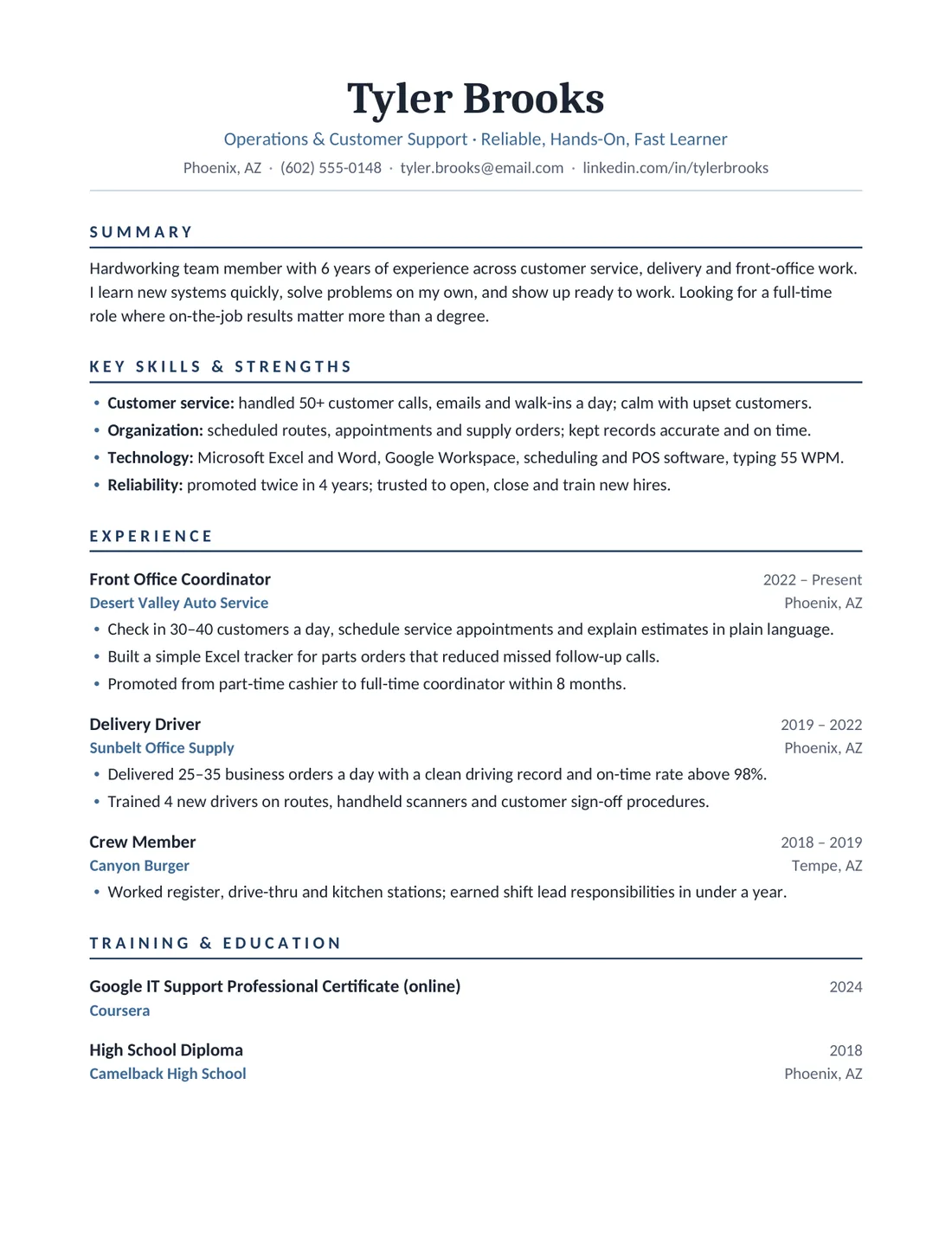
Recruiters scan the top third of a resume first. On a traditional resume, education sits near the top. Without a degree, you want that space for what makes you hireable:
- Header with a clear target title
- Summary: experience, strengths and the role you want
- Key Skills & Strengths: four to six skills, each with a short proof
- Experience: results-focused bullets
- Training & Education: certificates, courses, high school or GED, at the bottom
This is a hybrid format: skills up front, but with a full, dated work history. Avoid the old “functional” resume that lists skills and hides dates. Recruiters often assume something is being hidden.
Header: aim at a specific job
Under your name, write the job you want, not the job you had: Operations Coordinator, Customer Support Specialist, Maintenance Technician. If you want, add two or three strengths after it: Operations & Customer Support · Reliable, Hands-On, Fast Learner.
Summary: replace credentials with experience
Your summary should make a hiring manager think “this person has done the work”. Name your years of experience, the kinds of work, and what you’re looking for:
Example: Hardworking team member with 6 years across customer service, delivery and front-office work. I learn new systems quickly, solve problems on my own, and show up ready to work. Looking for a full-time role where on-the-job results matter more than a degree.
You don’t need to mention the degree at all. Let your experience speak.
Key Skills & Strengths: claims with receipts
Instead of a plain list of keywords, write each skill with a short proof:
Example skills section (fictional):
- Customer problem solving: handled 40+ customer questions a day and resolved most without escalation.
- Learning new systems fast: trained on three different scheduling and POS systems; became the go-to person for each.
- Reliability: no missed shifts in 2 years; regularly covered extra shifts.
- Scheduling and logistics: planned daily delivery routes for a team of 4 drivers.
Use the job posting to choose which skills to feature. If it asks for “data entry accuracy” and “Microsoft Excel”, those should appear here and in your bullets, as long as you actually have them.
Experience: show increasing responsibility
Employers who skip the degree requirement are looking for evidence you can grow. Show that you took on more over time:
Example bullets (fictional, replace with your own):
- Promoted from delivery driver to dispatch lead within 18 months; now schedule routes and handle customer calls for a 6-person team.
- Built a simple Excel tracker for late deliveries that helped the manager spot problem routes; adopted by the whole branch.
- Trained 8 new hires on safety procedures, the handheld system and customer service standards.
- Handled front-desk check-ins, phones and payments for a busy auto repair shop, keeping wait times down during rush hours.
Promotions, training others, being trusted with keys or cash, and building small improvements are all strong signals that stand in for a credential.
Don’t skip “non-traditional” experience
Gig work, freelance projects, family business work, military service, caregiving with real responsibility, and serious volunteer roles all count if they’re relevant. Give them a job title, dates and bullets like any other job.
Training & Education: honest and complete
This section goes last, and it should list everything that shows learning:
- Certifications and licenses: for example CompTIA A+, forklift, CDL, OSHA 10, Google Career Certificates, food safety manager, real estate license
- Apprenticeships and trade programs
- Employer training programs (a company’s leadership or safety course)
- College coursework without a degree: “Business coursework, Front Range Community College, 2019–2020”
- High school diploma or GED
Never write a degree you didn’t finish, and don’t list a college in a way that implies graduation. Background checks verify degrees, and getting caught costs far more than the missing line.
Handling “degree required” postings
- Read the full requirement. Many postings say “bachelor’s degree or equivalent experience”. If you have the experience, apply.
- Mirror the skills, not the credential. Show each listed skill in your summary or bullets.
- Use your cover letter. One sentence can address it directly: “While I don’t have a college degree, I’ve spent six years doing this work, including two years leading a team.”
- Look for skills-based employers. Many large employers and state governments have removed degree requirements for a range of jobs. Searching job boards for “no degree required” or “equivalent experience” helps.
Every ResumeForge template comes with a matching cover letter. Our cover letter format guide shows a simple structure.
Changing fields without a degree?
If you’re moving into a new kind of work entirely, combine this approach with the tips in our career change resume guide, which covers transferable skills and hybrid formats in more depth.
Examples by background
- Warehouse and logistics: equipment, certifications, rate, safety. See our warehouse resume skills guide.
- Retail and restaurant: customer results, cash accuracy, training others. See our retail associate and server guides.
- Sales: sales is one of the most merit-based fields. Numbers beat diplomas. See our car sales and B2B sales guides.
Common mistakes on a no-degree resume
- Apologizing for the missing degree in your summary. Lead with strengths instead.
- Leaving education blank. A high school diploma, GED or certificate is worth listing.
- Hiding dates with a functional format.
- Generic skills lists with no proof.
- Overdesigned layouts. Plain single-column resumes read best in online applications. See how to choose an ATS-friendly template.
Choosing a resume template without a degree
Look for a template that puts a skills section above experience and keeps education at the bottom. The Groundwork no-degree resume template is built exactly that way, with a Key Skills & Strengths section, full work history and a Training & Education block, plus a matching cover letter. Keystone works well if you’re earlier in your career, and Depot is built for warehouse and logistics jobs.
Before you apply
- Your target title is under your name.
- The top third shows your experience and skills, not your education.
- Every skill you claim is backed by a bullet.
- Training & Education is honest and complete.
- You’ve checked it against the free Résumé Checklist.
Free download
The Résumé Checklist
38 practical checks to run before you hit send, from your header and bullets to ATS formatting and file names. A 3-page PDF, free.
Frequently asked questions
How do I list education on a resume if I don't have a degree?
List what you do have: your high school diploma or GED, any college coursework (for example 'Business coursework, Front Range Community College, 2019–2020'), certificates, apprenticeships and job training. Put the section at the bottom, title it 'Training & Education', and never imply a degree you didn't finish.
Should I apply if the job says a degree is required?
Often, yes, especially if you meet most of the other requirements and the posting says 'or equivalent experience'. Many employers have dropped degree requirements for skills-based hiring. Show the equivalent experience clearly in your summary and bullets, and mention it in your cover letter.
What resume format is best without a degree?
A skills-first or hybrid format: a short summary, a 'Key Skills & Strengths' section backed by real examples, then your work experience, then training and education at the bottom. Avoid a purely functional resume that hides dates, because recruiters tend to distrust it.
Do certificates count on a resume without a degree?
Yes. Industry certifications, licenses, apprenticeships, bootcamps and online certificates from recognized providers all show initiative and specific skills. List the issuer and the year.
How is this different from an entry-level resume with no experience?
An entry-level resume is for people with little work history, so education often goes first. A no-degree resume is usually for people who have work experience but no diploma from college, so experience and skills go first and education goes last.