Guide
How to Write a Career Change Resume That Makes Sense to a New Industry
When you change careers, the reader of your resume is someone who doesn’t know your old industry. They won’t automatically see how “managed a 28-student classroom” relates to “facilitates stakeholder workshops”. Your resume has to make that connection for them.
Use a hybrid format
There are three common resume structures:
- Chronological: work history first. Good when your past roles already match the target.
- Functional: skills first, little or no timeline. Often looks like you’re hiding something.
- Hybrid (combination): a short transferable-skills section, then a normal reverse-chronological history.
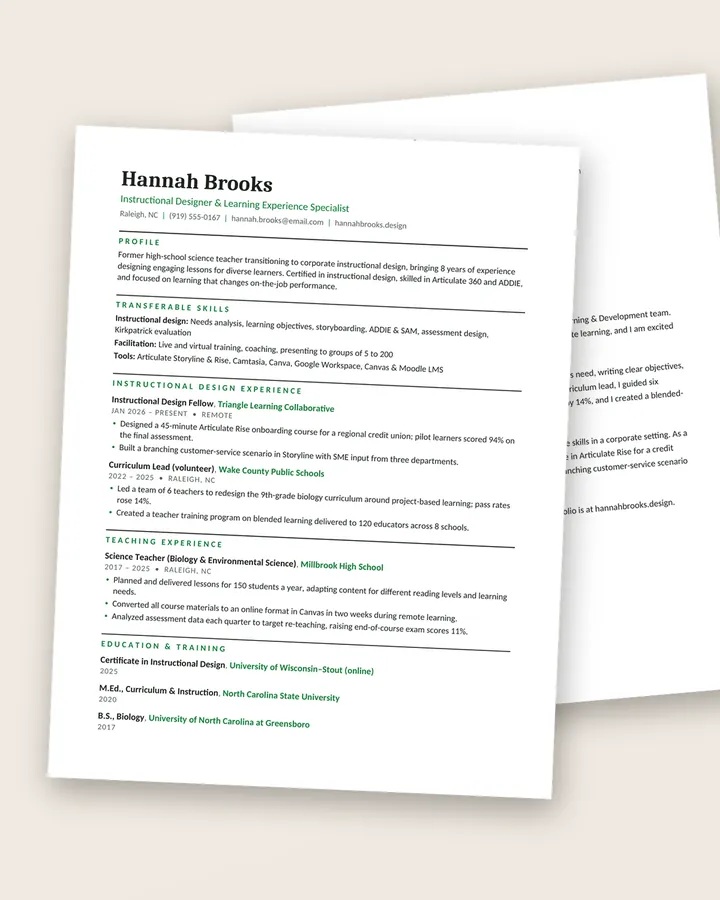
For most career changers, hybrid is the right choice. It puts the relevant evidence first without hiding your timeline. Our Pivot career change resume template is built on exactly this structure: Profile → Transferable Skills → new-field experience → previous career → Education & Training.
Write a summary that explains the move
Your summary should answer three questions in two or three lines: What are you moving into? What carries over? What have you done to prepare?
Former high school science teacher moving into instructional design. Eight years designing curricula and assessments for varied learners; completed a certificate in learning experience design and built three e-learning modules in Articulate Storyline.
That’s specific, honest and gives the reader a reason to keep going.
Build a transferable-skills section
Pick three to five skills the target job asks for and that you have genuinely used. Under each, give one line of evidence from your previous career.
- Needs analysis: surveyed students and parents each term to adjust the curriculum to learning gaps.
- Content design: wrote and sequenced a full-year chemistry course, including labs and assessments.
- Stakeholder communication: presented program changes to department heads and parent groups.
Use the target industry’s vocabulary, which you can find in job postings, so that both recruiters and applicant tracking systems recognize it.
Translate your past experience
Go through each previous role and rewrite bullets around outcomes and skills a new employer cares about, rather than duties specific to your old field.
| Old-field phrasing | Translated |
|---|---|
| Taught five sections of biology | Delivered training to 140+ learners weekly across five cohorts |
| Department chair | Led a team of six; ran budgeting and scheduling for the department |
| Served customers at the front desk | Resolved customer issues and handled billing in a high-volume clinic |
Only use numbers you can stand behind. Ranges and approximate counts (“about 140”) are fine when they’re honest.
Show the bridge: training, projects and volunteering
Career changers often have the most persuasive evidence outside their old job:
- Courses, certificates and bootcamps (with completion dates)
- Portfolio projects or freelance work in the new field
- Volunteering or side projects that used the new skills
Give these real entries with bullets, not a single line at the bottom.
Use your cover letter to tell the story
The resume shows the evidence; the cover letter explains the why. Keep it short: why this field, why now, what you bring, and what you’ve already done to prepare. Our cover letter format guide gives a structure you can follow, and every template includes a matching letter.
Keep it readable for software too
Hybrid resumes still need standard headings and a clean single-column layout. Run through the checklist in how to make an ATS-friendly resume before you apply.
Free download
The Résumé Checklist
38 practical checks to run before you hit send, from your header and bullets to ATS formatting and file names. A 3-page PDF, free.
Frequently asked questions
Should I use a functional resume for a career change?
A purely functional resume (skills only, with dates hidden) often makes recruiters suspicious. A hybrid format is usually better: a transferable-skills section at the top, followed by a normal reverse-chronological work history.
Do I need to explain my career change on my resume?
Briefly, yes. One or two lines in your summary are enough on the resume. Save the fuller story for the cover letter.
Should I leave old, unrelated jobs off?
Keep them if removing them would create unexplained gaps, but shorten them to one or two bullets that highlight transferable skills. Relevant training, courses and projects can take up the space instead.