Guide
CV vs Resume: What's the Difference, and Which One Do You Need?
The short answer: in the United States and Canada, a resume is a brief, tailored summary of your work, while a CV (curriculum vitae) is a complete record of your academic and professional history. In the UK, Ireland, Australia and much of Europe, “CV” is usually just the everyday word for a resume.
So the first question isn’t “which is better?” but “what does this employer, in this country and this field, mean?”
The main differences
| Resume | CV (academic / North American sense) | |
|---|---|---|
| Purpose | Persuade an employer you fit this role | Document your full scholarly record |
| Length | Usually 1–2 pages | As long as your record requires |
| Tailoring | Heavily tailored per application | Mostly stable; reordered for emphasis |
| Typical sections | Summary, experience, skills, education | Education, appointments, publications, grants, teaching, presentations, service |
| Used for | Most private-sector and government jobs | Faculty, research, postdoc and fellowship roles, grad school, some medical and scientific roles |
When you need a CV
Use a full CV when you’re applying for:
- Faculty, lecturer and postdoctoral positions
- Research fellowships and grants
- Graduate school (often a short student CV)
- Some research, scientific and clinical roles where publications matter
If a US job posting in industry says “CV”, it very often means a resume. When in doubt, look at what the posting asks you to demonstrate: if it wants publications and teaching, send a CV; if it wants results in a role, send a resume.
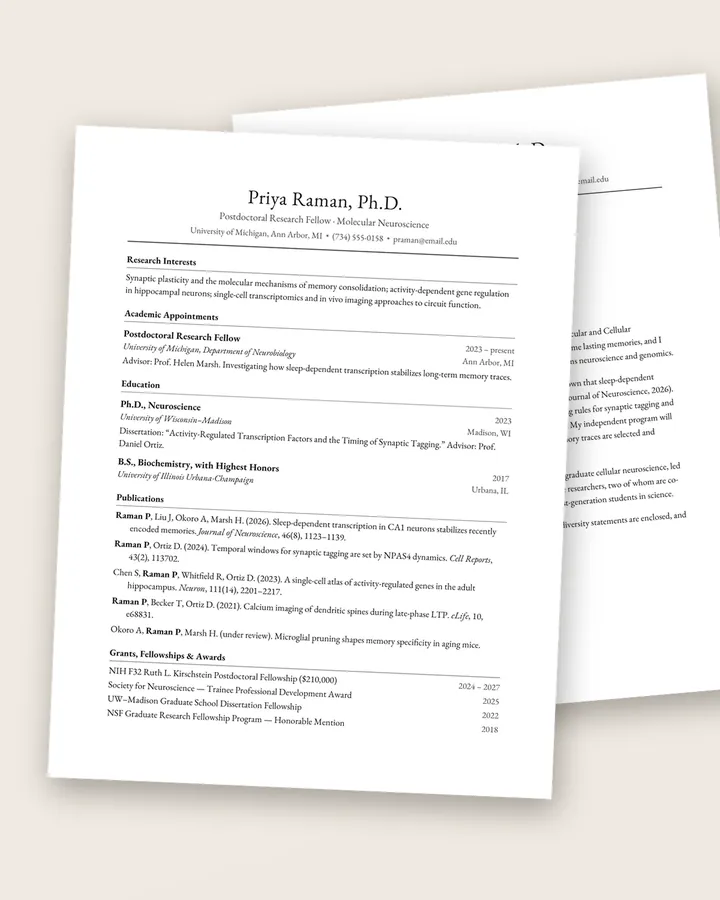
What goes on an academic CV
Order sections by what matters most for the role. A research-focused position usually puts publications high; a teaching-focused one moves teaching up.
- Contact information and current appointment
- Research interests (2–4 lines)
- Academic appointments
- Education: degrees, institutions, years; dissertation title and advisor
- Publications: split into peer-reviewed articles, books/chapters, under review and in preparation; use one citation style consistently
- Grants, fellowships and awards
- Presentations: invited talks and conference presentations
- Teaching experience: courses, role (instructor of record or teaching assistant), institution and term
- Mentoring, service and professional memberships
- Skills: methods, languages, software
- References (often three, with contact details, if the field expects them on the CV)
The Scholar academic CV template is laid out in this order, as a clean two-page Word document that stays editable as your publication list grows.
How to turn a CV into a resume
Moving from academia to industry is common, and the conversion is mostly about cutting and translating:
- Lead with a summary that names the role you want and the skills that carry over (analysis, project management, writing, teaching, specific methods).
- Turn appointments into experience entries with bullets that describe outcomes, such as a study you designed, a dataset you built or a lab you managed, in plain language.
- Select, don’t list. Replace the full publication list with a short “Selected publications” section, or drop it if the role doesn’t value it.
- Add a skills section with the tools a hiring manager will search for.
- Aim for one to two pages.
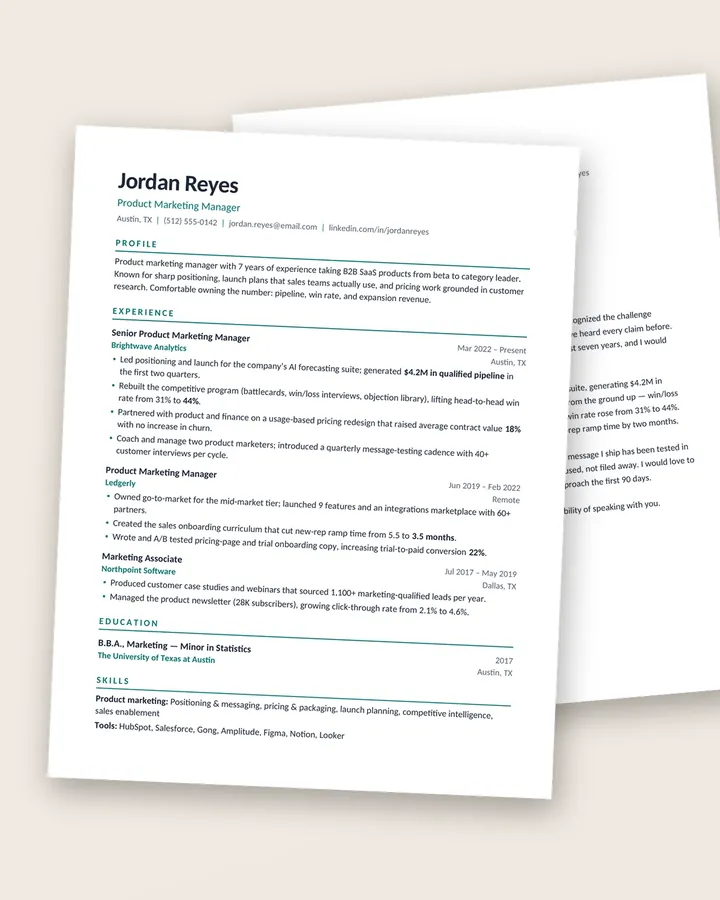
A modern single-column layout such as the Meridian modern resume template works well for the converted version. Our career change resume guide covers the “transferable skills” part in more detail.
Formatting rules for both
- Use a clear, conventional font and consistent dates.
- Put your name on every page (a header with name and page number works well on multi-page CVs).
- Keep section headings standard so both people and applicant tracking systems can find things. See how to make an ATS-friendly resume.
- Export to PDF unless asked for Word.
Free download
The Résumé Checklist
38 practical checks to run before you hit send, from your header and bullets to ATS formatting and file names. A 3-page PDF, free.
Frequently asked questions
Is a CV the same as a resume in the UK?
In the UK, Ireland, Australia, New Zealand and much of Europe, 'CV' is the everyday word for the short document Americans call a resume. A full academic CV still exists there, but for most job applications 'CV' simply means resume.
Do I need a CV for grad school?
Many graduate programs ask for a CV. As a student it will be short, often one to two pages, focused on education, research experience, presentations, awards and relevant skills. Use the program's instructions if they give a format.
Can a CV be one page?
Yes, early in an academic career. A CV grows with your record, so length isn't the defining feature. Completeness is: a CV lists all your scholarly work rather than a selection.