Guide
Teacher Resume Template: What Principals Look For (With Examples)
A principal or hiring committee reading teacher resumes is usually doing it between classes, meetings and everything else. They want to confirm three things quickly: you hold (or are about to hold) the right license, you’ve taught the grade level or subject they need, and you can manage a classroom well. A good teacher resume template puts those answers where they’re seen first.
This guide walks through each section of a teacher resume, in order, with example wording you can adapt.
1. Header: make it easy to contact you
Use your full name in the largest text on the page, then a line with your city and state, phone, email and (optionally) a link to a teaching portfolio or LinkedIn profile. A full street address isn’t needed.
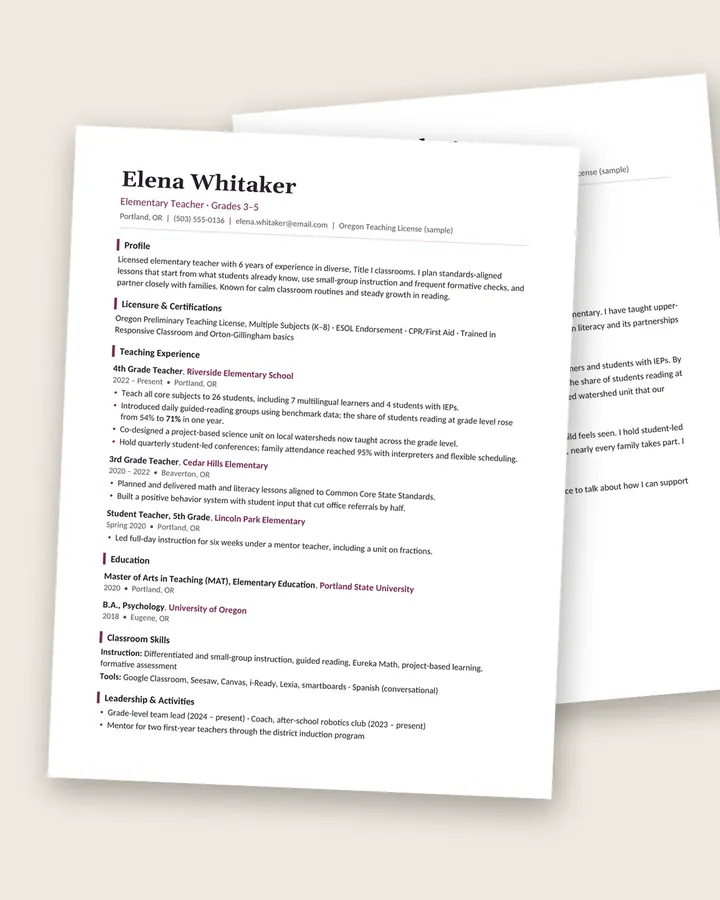
If your license is a key requirement, you can add it to the header line, as in our Primer teacher resume template. That way it’s visible even in a five-second skim.
2. Profile: two or three sentences
Skip “dedicated educator seeking a rewarding position”. Instead, answer who you teach, how you teach and what results you get:
Licensed elementary teacher with 6 years of experience in diverse, Title I classrooms. I plan standards-aligned lessons, use small-group instruction and frequent formative checks, and partner closely with families.
Mirror the language in the job posting where it’s honestly true for you: “multilingual learners”, “PBIS”, “project-based learning”, “co-teaching”.
3. Licensure and certifications, near the top
For most teaching jobs, licensure is a screening requirement, so give it its own short section right after your profile:
- License type, subject or grade band, and state
- Endorsements (ESOL/ELL, Special Education, Reading Specialist)
- Relevant training (Orton-Gillingham, Responsive Classroom, CPR/First Aid)
- “Expected June 2026” if your license is pending
4. Teaching experience: grade, students, results
Each role gets the job title, school, city and dates. Then use bullets to show the context (grade level, class size, student population) and the results.
Weak bullets list duties every teacher has:
- Planned lessons and graded assignments.
- Communicated with parents.
Strong bullets show what changed because you were there:
- Introduced daily guided-reading groups using benchmark data; the share of students reading at grade level rose from 54% to 71% in one year.
- Hold quarterly student-led conferences; family attendance reached 95% with interpreters and flexible scheduling.
- Co-designed a project-based science unit now taught across the grade level.
You don’t need test-score gains for every bullet. Good evidence also includes attendance, behavior referrals, family engagement, units you designed, programs you started and teachers you mentored. Use honest numbers or ranges; never invent data.
New teachers: student teaching goes here. Treat it like a job: school, grade, dates, and one or two specific things you planned or led, like “Led full-day instruction for six weeks, including a unit on fractions.”
5. Education
List your degree, school and year, plus a teacher-preparation program or MAT if you have one. New graduates can add relevant coursework or honors. Experienced teachers can keep this section short.
6. Classroom skills and tools
Group skills so they’re easy to scan:
- Instruction: differentiated instruction, guided reading, Eureka Math, project-based learning, formative assessment
- Tools: Google Classroom, Seesaw, Canvas, i-Ready, interactive whiteboards
- Languages: Spanish (conversational)
Only include what you can talk about confidently in an interview or demo lesson.
7. Leadership and activities
Coaching, clubs, committees, grade-level lead roles and mentoring all show you contribute beyond your own classroom. One or two lines is enough.
Choosing a teacher resume template
When you compare templates, check for:
- A single-column layout. Many districts use online application systems (such as Frontline/AppliTrack or SchoolSpring) that parse your resume. Single-column templates with standard headings parse most reliably. See how to choose an ATS-friendly resume template.
- A dedicated licensure section so you aren’t hiding credentials in your education.
- Room for context under each role (grade, class size, population) without crowding.
- A matching cover letter. Most teaching applications ask for one. Our templates include a matching cover letter with a complete example you can adapt.
- Fonts available everywhere. If you’ll edit in Google Docs on a school Chromebook, stick to fonts that exist in both Word and Docs, such as Calibri, Georgia or Arial.
Primer is built around exactly this structure. If you’re a brand-new graduate with mostly coursework and student teaching, Launch puts education first, and Clarity is our plainest, most ATS-focused option.
Quick checklist before you apply
- License and endorsements are visible in the top third of the page.
- Each role shows grade level or subject and at least one specific result.
- Your profile names the grades or subjects you’re applying to teach.
- The resume matches the posting’s key terms where they’re true for you.
- You’ve saved a PDF named Firstname-Lastname-Resume.pdf (unless the district asks for Word).
For a full pre-send list, grab the free Résumé Checklist.
Free download
The Résumé Checklist
38 practical checks to run before you hit send, from your header and bullets to ATS formatting and file names. A 3-page PDF, free.
Frequently asked questions
Should a teacher resume be one or two pages?
One page is usually enough for new teachers and teachers with under about ten years in the classroom. Experienced teachers with leadership roles, curriculum work or several schools can use two pages, as long as the most relevant teaching experience is on page one.
Do I need an objective on a teacher resume?
A traditional objective statement isn't necessary. A short profile of two or three sentences that names your grade levels, subject areas and a strength or two does the same job better.
Should I include student teaching on my resume?
Yes, if you are a new or recent graduate. List the school, grade level, dates and one or two specific things you planned or led. Once you have a few years of paid teaching, you can shorten or remove it.
How do I list my teaching license?
Give the license name, subject or grade band, and the state, for example 'Preliminary Teaching License, Multiple Subjects (K–8), Oregon'. Add endorsements such as ESOL or Special Education on the same line or the next.