Guide
Retail Sales Associate Resume: What Store Managers Want to See
Retail hiring moves fast. A store manager may review applications on a tablet in the back room, between unloading a truck and covering a register. They’re looking for someone who is reliable, friendly with customers, accurate with money and available when the store needs help. Your resume should show all four on one page.
This guide is specifically about sales associate, cashier, stock and seasonal retail jobs. (If you’re applying to call centers or front-desk roles, our customer service resume guide is the better fit.) The example bullets are illustrations. Use your own stores and numbers.
What store managers look for first
- Availability. Evenings, weekends and holidays matter more in retail than almost anywhere else.
- Reliability. Showing up on time, every time, and covering shifts when needed.
- Customer service. Greeting people, helping them find things, handling returns without drama.
- Accuracy. Balanced drawers, correct pricing, careful handling of returns and exchanges.
- Store goals. Many stores track loyalty sign-ups, credit card applications, add-on sales or units per transaction.
Header and title
Name, then Retail Sales Associate (or Cashier, Stock Associate, or whatever the posting says), city and state, phone and email. Applying to a store in your town? Your city shows you’re local, which managers like.
Summary: two lines on where and how you’ve worked
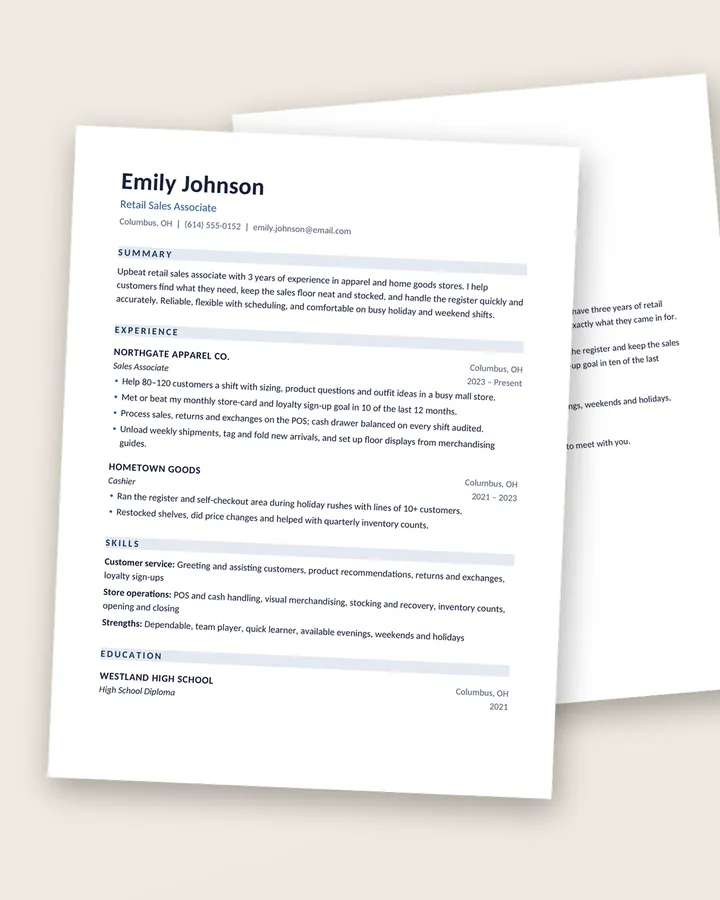
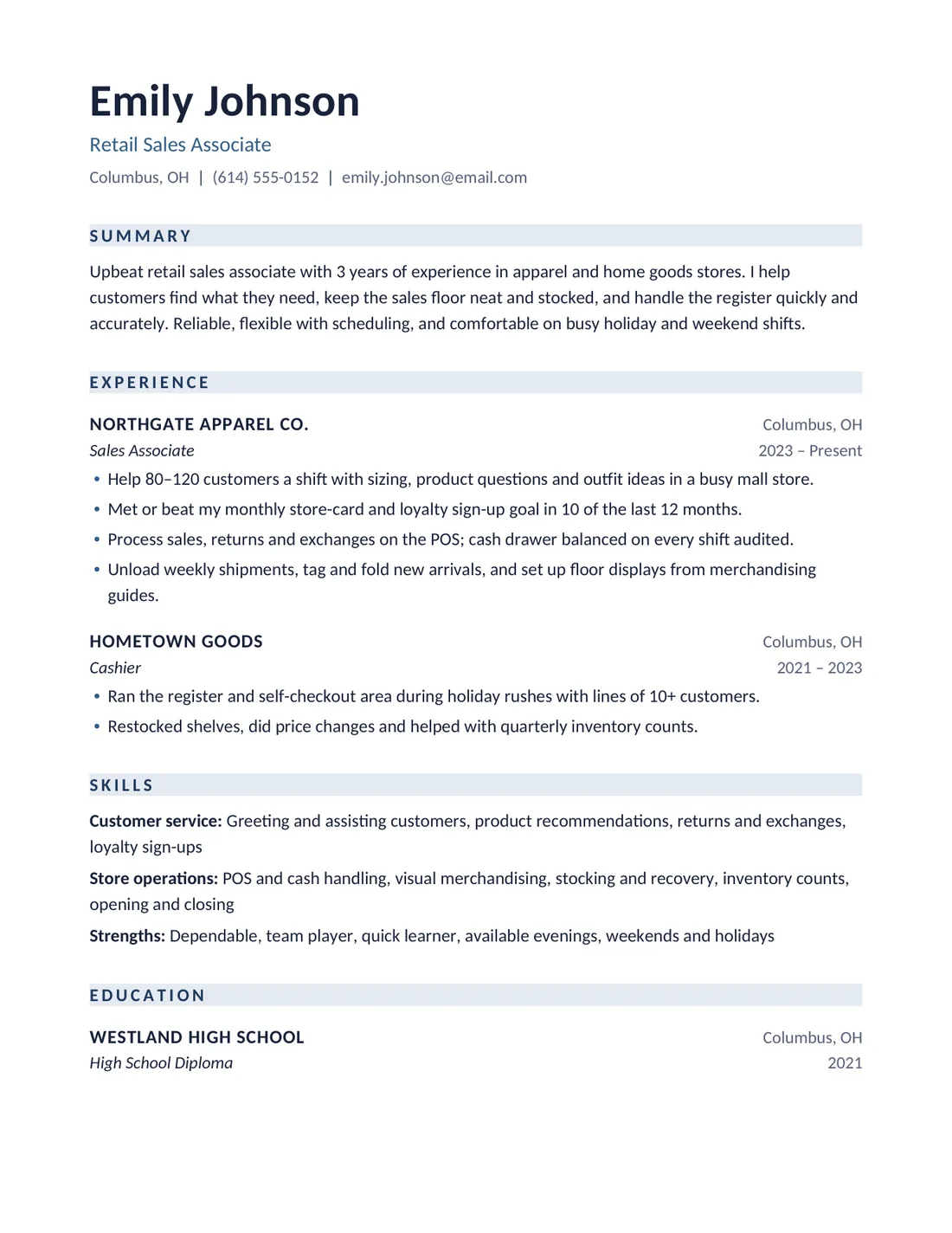
Example: Upbeat retail sales associate with 3 years in apparel and home goods stores. I help customers find what they need, keep the floor neat and stocked, and handle the register quickly and accurately. Reliable, flexible with scheduling, and comfortable on busy holiday and weekend shifts.
For a first retail job, focus on traits you can prove: “Dependable high school senior with volunteer and babysitting experience, available evenings and weekends, and comfortable handling money.”
Experience: turn duties into results
“Helped customers, ran register, stocked shelves” is what every retail resume says. Add the scale, the accuracy or the outcome.
Example bullets (fictional, replace with your own):
- Help 80–120 customers on a typical Saturday in a busy apparel store, finding sizes, suggesting outfits and handling returns and exchanges.
- Balanced my register drawer on every shift for the past year and was trusted to count down drawers at close.
- Regularly met or beat the store’s weekly loyalty sign-up goal by mentioning the program to every customer at checkout.
- Set up seasonal displays and floor sets from corporate planograms, and restocked the floor during and after peak hours.
- Trained 5 seasonal hires on the POS, returns policy and fitting room procedures during the holiday rush.
Retail numbers you might have
You may know more than you think. Stores commonly track:
- Loyalty or rewards sign-ups and store credit card applications
- Units per transaction or add-on sales
- Customer survey scores or mentions by name
- Drawer accuracy or cash-handling audits
- Shrink or loss-prevention results for your department
- Number of customers or transactions on a busy day
If you don’t have exact numbers, honest descriptions work: “regularly asked to cover the fitting room on weekends”, “trusted with opening and closing keys”.
Stock and merchandising roles
If you worked on the back end, show the volume and the accuracy:
- Unloaded and processed weekly trucks of 1,000+ units, getting product to the floor before opening.
- Completed inventory counts and price changes accurately and on schedule.
- Kept stockroom organized so associates could find sizes quickly.
If you’re moving from stock work into a warehouse or distribution center, our warehouse resume skills guide shows how to present that experience.
Skills: a short grouped list
- Customer service: greeting and helping customers, returns and exchanges, handling complaints, product recommendations
- Register and cash: POS checkout, cash and card handling, drawer counts, gift cards and loyalty programs
- Store operations: stocking, merchandising and planograms, inventory counts, opening and closing, fitting rooms
- Systems: the POS systems you’ve used (for example Square, NCR or Lightspeed), handheld scanners
- Languages: list them. Customers will appreciate it, and so will managers.
Education
High school diploma, GED, current school or college. That’s all a retail resume needs. If you’re still in high school, it’s fine to list your expected graduation date.
Availability and the application form
Most retailers ask about availability on the online application. Answer honestly and as broadly as you can. Then reinforce it in a short cover letter: “I’m available weekday evenings, all weekend, and every day of the holiday season.” For holiday jobs, apply early: many stores begin seasonal hiring months before the holidays.
Your cover letter can be four sentences: the store and role, why you like shopping or working there, one example of great service, and your availability. Every ResumeForge template includes a matching cover letter, and our cover letter format guide explains the layout.
Common retail resume mistakes
- Only listing duties. Add at least one result or scale detail per job.
- Leaving out short or seasonal jobs. Holiday and summer jobs are relevant retail experience. Label them “Seasonal”.
- Unprofessional email address. Use a simple name-based address.
- Two pages. One page is right for almost every retail role.
- Complicated layouts. Big retailers use online application systems that read simple, single-column resumes best. See how ATS-friendly templates work.
Ready for a lead or supervisor role?
If you’re aiming at key holder, team lead or assistant manager, add bullets about opening and closing the store, managing breaks and coverage, training new hires, and hitting store or department goals. Responsibility for keys and cash is a big trust signal.
Choosing a retail sales associate resume template
The Avenue retail associate resume template is laid out the way store managers read: summary, store experience with register and goal results, grouped skills and education, plus a matching cover letter. For roles that mix retail with phone or front-desk work, try Harbor. If you’re moving from hourly retail into a full-time role without a degree, Groundwork puts your skills first. For a first job with little history, see our entry-level resume guide.
Before you apply
- Your title matches the posting (sales associate, cashier, stock associate).
- Every job has at least one result or scale detail.
- Your POS and cash-handling experience is easy to spot.
- Your availability is in the application and cover letter.
- You’ve checked it against our free Résumé Checklist.
Free download
The Résumé Checklist
38 practical checks to run before you hit send, from your header and bullets to ATS formatting and file names. A 3-page PDF, free.
Frequently asked questions
What should a retail sales associate put on a resume?
The stores you've worked in and what they sell, how you helped customers, register and cash accuracy, sales or loyalty sign-up goals you met, stocking and merchandising work, opening or closing duties, and the POS systems you know. Keep each bullet short and specific.
How do I write a retail resume with no experience?
Use school, volunteering, babysitting, family business work, sports or clubs to show reliability, friendliness, handling money and working on a team. Put your availability in the application, apply early for seasonal roles, and keep the resume to one clear page.
What skills do retail employers look for?
Customer service, reliability and flexible availability, cash handling, basic math, product knowledge, teamwork, stocking and merchandising, and comfort with a POS system. Bilingual skills are a strong plus in many stores.
Should I include a cashier job on a sales associate resume?
Yes. Cashier work shows cash handling, accuracy, speed and customer service, which are core sales associate skills. Describe it with results, such as drawer accuracy or loyalty sign-ups.
When should I apply for seasonal retail jobs?
Many stores start holiday hiring in late summer or early fall. Applying early, and saying you can work evenings, weekends and holidays, gives you the best chance.