Guide
Warehouse Resume Skills: What to List and How to Prove It
Warehouse supervisors hire for a short list of things: can you run the equipment, will you hit rate without cutting corners on safety, and will you show up for every shift, including peak season? A strong warehouse resume puts those skills where they look first, then proves them with short, specific bullets.
This guide focuses on the skills section and how to back it up. The example bullets are illustrations. Replace them with your own work and numbers.
The warehouse skills that matter most
1. Equipment and certifications
This is often the first thing a recruiter checks. List the specific equipment you can operate:
- Sit-down and stand-up forklift
- Reach truck, order picker, turret truck
- Electric and manual pallet jacks
- Dock equipment, stretch wrappers, balers
- Box trucks or company vehicles (if you have the right license)
Many employers train and evaluate operators on their own equipment, so be accurate about what you were trained and authorized to use, and roughly when. “Forklift certified (sit-down and reach truck), last recertified 2025” is clear and honest.
2. Scanners and warehouse systems
Most warehouses run on handheld RF scanners and a warehouse management system (WMS). If you’ve used them, say so. Name the systems if you know them (for example Manhattan, SAP, Oracle or a company’s in-house system) and the tasks you did with them: picking, putaway, cycle counts, receiving.
3. Productivity and accuracy
Supervisors measure rate (units or lines per hour) and accuracy (mis-picks, damages, shipping errors). If you consistently met or beat rate, that’s one of your strongest selling points. Pair it with accuracy so it doesn’t look like you rush.
4. Safety
A good safety record saves a warehouse money and keeps people healthy. Mention safety training, safety committee roles, no-incident streaks and habits like pre-shift equipment inspections.
5. Reliability and stamina
Attendance matters more in warehouses than most jobs, because one missing picker slows a whole line. If you had perfect attendance streaks, volunteered for overtime or worked peak season, include it. It’s also fair to state you can lift a specific weight and stand for long shifts if the posting asks.
How to prove each skill with bullets
A skills list alone isn’t enough. Every skill in your list should show up again in a bullet with context.
Example bullets (fictional, replace with your own):
- Pick and pack orders in a 400,000 sq ft e-commerce distribution center using an RF scanner, consistently above the hourly rate goal with high accuracy.
- Operate sit-down forklift and reach truck for putaway and replenishment up to 30 ft racking; daily pre-shift inspections, no incidents in 3 years.
- Receive 8–12 inbound trailers per shift: verify counts against packing lists, flag damages and enter receipts in the WMS.
- Lead cycle counts for two zones each week, helping keep inventory accuracy above the site target.
- Perfect attendance for 18 months, including mandatory overtime during peak season.
- Trained 10+ new associates on scanner use, safe lifting and zone layout.
Where to find your numbers
Ask yourself or check old performance reviews for:
- Your average rate compared to the goal
- Accuracy or error rates
- Trailers, pallets or orders per shift
- Size of the building or number of SKUs
- Attendance records and safety awards
If you don’t have exact numbers, honest scale words work: “high-volume”, “peak-season”, “two-shift operation”. Don’t invent a precise rate you can’t explain.
Organizing your warehouse resume
This order works well for most warehouse jobs:
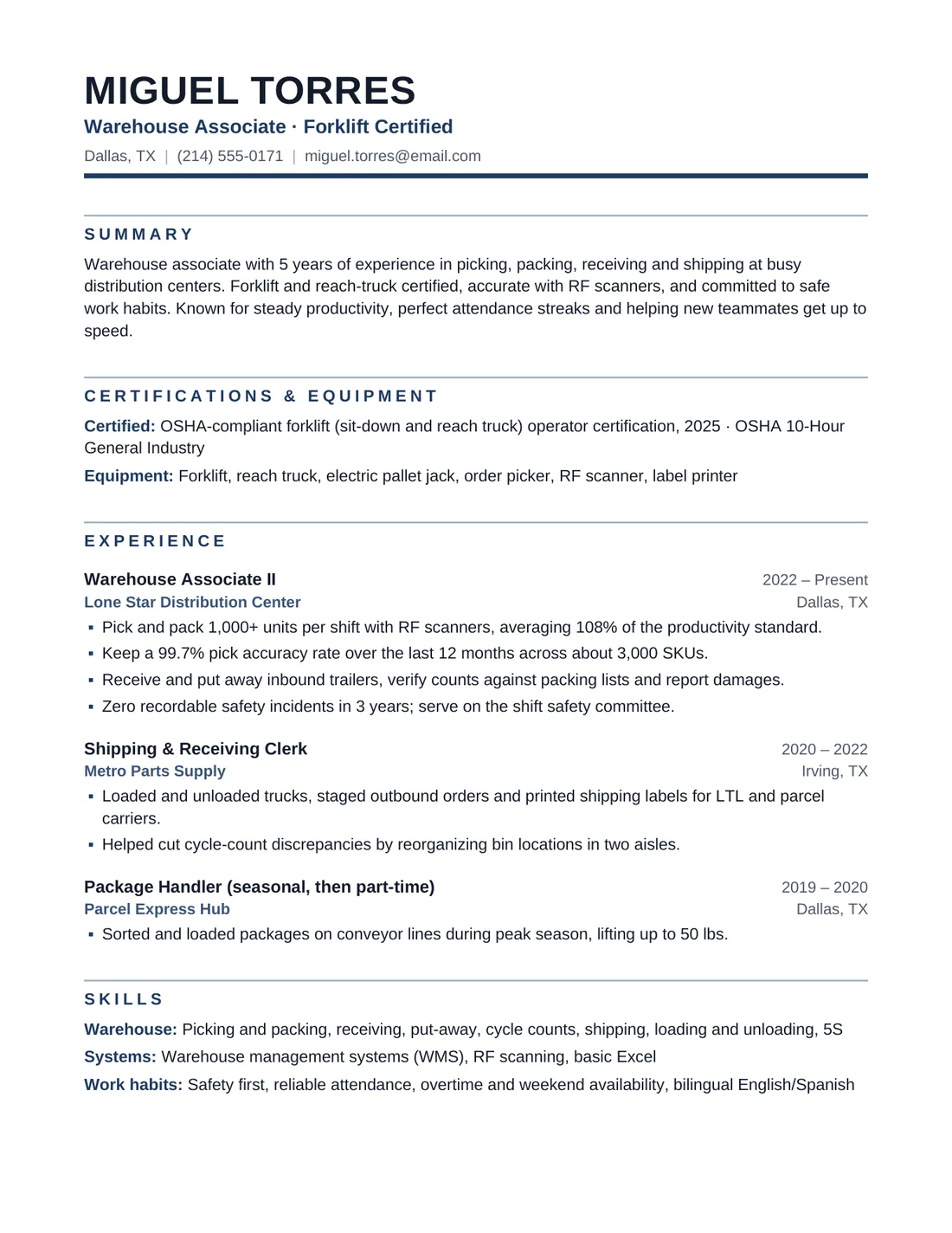
- Header: name, title (Warehouse Associate · Forklift Certified), city and state, phone, email
- Summary: two or three sentences
- Certifications & Equipment: a short block near the top
- Experience: most recent first, three to five bullets each
- Skills: grouped
- Education & training: high school or GED, safety courses
Example summary: Warehouse associate with 5 years of picking, packing, receiving and shipping at busy distribution centers. Forklift and reach-truck certified, accurate with RF scanners, and committed to safe work habits. Known for steady productivity and helping new teammates get up to speed.
A grouped skills section
- Equipment: sit-down forklift, reach truck, electric pallet jack, stretch wrapper
- Systems: RF scanners, WMS (name it if you know it), Microsoft Excel basics
- Operations: picking, packing, receiving, putaway, cycle counts, shipping and loading
- Safety: OSHA-compliant practices, lockout/tagout awareness, equipment inspections, safe lifting
Only list what you’ve actually done. Supervisors may test you on equipment during a tryout or first day.
Moving into warehouse work from another job
Retail stock associates, restaurant kitchen staff, movers, delivery drivers and landscapers all have relevant skills. Translate them:
- Retail stock: processed trucks, used handheld scanners, kept the stockroom organized.
- Kitchen: worked fast under pressure, followed safety and sanitation rules, received deliveries.
- Moving or delivery: heavy lifting, loading trucks efficiently, careful handling, route timing.
If your experience comes mostly from retail, our retail associate resume guide has examples for stock and merchandising roles. If you have no work history at all yet, see our entry-level resume guide.
Moving up to lead or supervisor
For lead, trainer or supervisor roles, add people results: training new hires, running a zone or shift, planning labor, improving a process. “Reorganized fast-moving SKUs closer to pack stations, cutting walking time for the zone” is the kind of bullet that gets a promotion conversation started. No degree? That’s common in warehouse leadership. See how to write a resume with no degree.
Your cover letter
Short and practical: the facility and role, your equipment and certifications, your best productivity or safety point, and the shifts you can work. Every ResumeForge template has a matching cover letter. See our cover letter format guide for the structure.
Common warehouse resume mistakes
- Burying certifications at the bottom of page two.
- Vague skills (“hard worker”, “team player”) with no proof.
- Guessed numbers. A made-up rate is easy to spot.
- Missing shift availability in the application or cover letter.
- Heavy formatting. Most large employers use online applications. A plain single-column resume reads best. See what makes a template ATS-friendly.
Choosing a warehouse resume template
The Depot warehouse associate resume template puts Certifications & Equipment right under your summary, with grouped skills and a matching cover letter in Word and Google Docs. If you’ve worked a mix of jobs and want skills front and center, try Groundwork. For the simplest layout possible, use Clarity.
Before you apply
- Equipment and certifications are in the top third of the page.
- Each skill you list appears in at least one bullet.
- Rate, accuracy, safety and attendance are covered honestly.
- Your shift availability is in the application or cover letter.
- You’ve checked it against the free Résumé Checklist.
Free download
The Résumé Checklist
38 practical checks to run before you hit send, from your header and bullets to ATS formatting and file names. A 3-page PDF, free.
Frequently asked questions
What are the most important skills for a warehouse resume?
Equipment you can operate (forklift, reach truck, pallet jack, order picker), RF scanner and warehouse system experience, picking and packing accuracy, productivity against rate, safety habits, attendance, and the ability to lift and stand for long shifts. Back each one up with a bullet in your experience section.
Should I put forklift certification on my resume?
Yes, near the top. Forklift and powered industrial truck training is usually done or confirmed by each employer, but showing that you were trained and authorized at a past job, with the equipment types, tells the supervisor you can get on the floor quickly. List the equipment types and when you were last certified.
How do I write a warehouse resume with no experience?
Use jobs that show physical work, reliability and accuracy: retail stocking, restaurant kitchens, landscaping, moving, delivery or farm work. Mention your willingness to work shifts, overtime and peak season, and any safety training you have.
Should I include my pick rate?
If you know it and it was good, yes, ideally compared to the goal (for example 'consistently above rate'). If you don't know the exact number, describe your productivity and accuracy honestly instead of guessing.
Is a one-page resume enough for warehouse jobs?
Yes. Warehouse supervisors and recruiters want to see your equipment, certifications, recent jobs and attendance quickly. One page is ideal.